











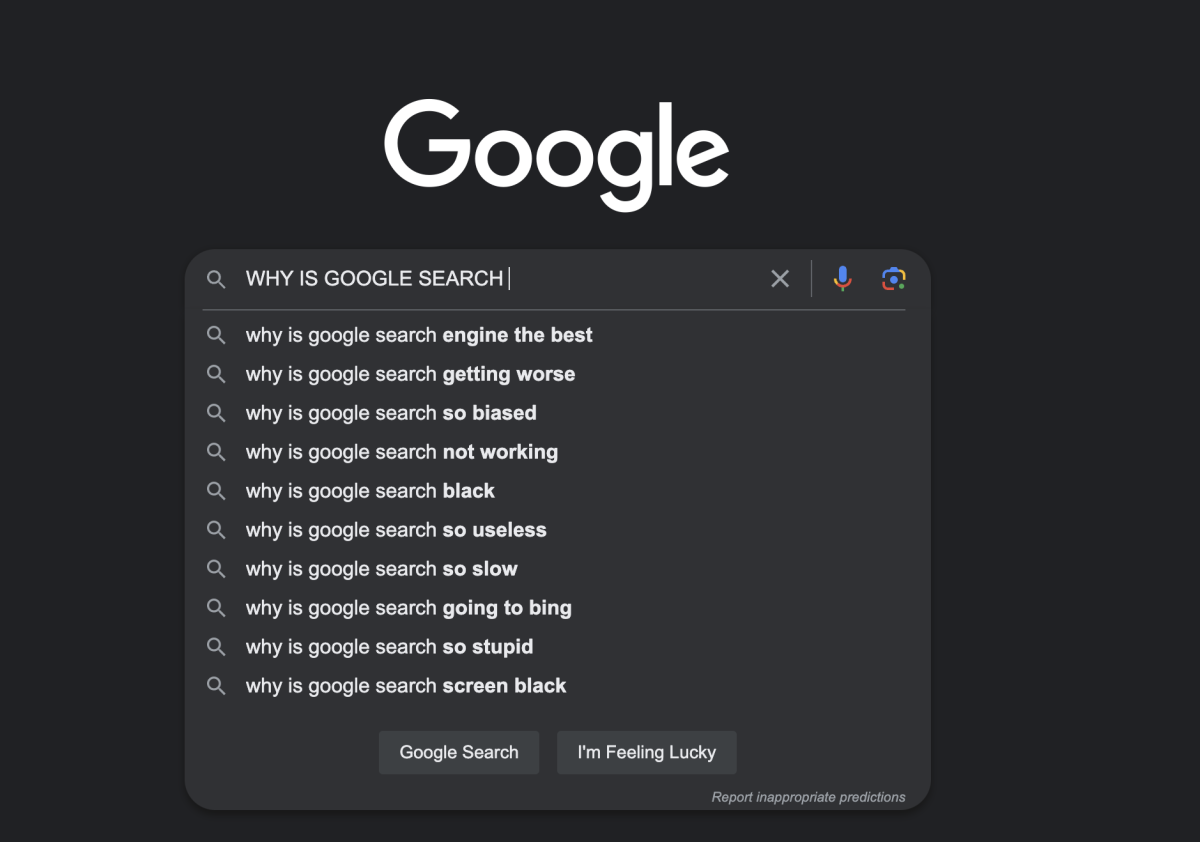
Just Google it. The name of the popular search engine Google has become the default verb to describe an internet search.
And up until recently, it was pretty effective for searching the internet. However, the past few years have seen a rise in complaints about the quality of search results on Google. Just look up “Google search results suck” and you’ll find Reddit posts of people complaining and news stories about how the search experience is getting worse. What’s causing the quality shift in Google Search results?
One major factor is Search Engine Optimization (SEO) spam. To explain SEO, we first have to know how the web works. Google, Bing, and Yahoo! all use crawlers (also known as spiders or bots) to collect information from the internet. Those crawlers add those pages that they crawl to an index. When the bot indexes a page, they add those pages to a list, which is what you see when you look up anything on any search engine. That’s how the web works in a very simplified explanation.
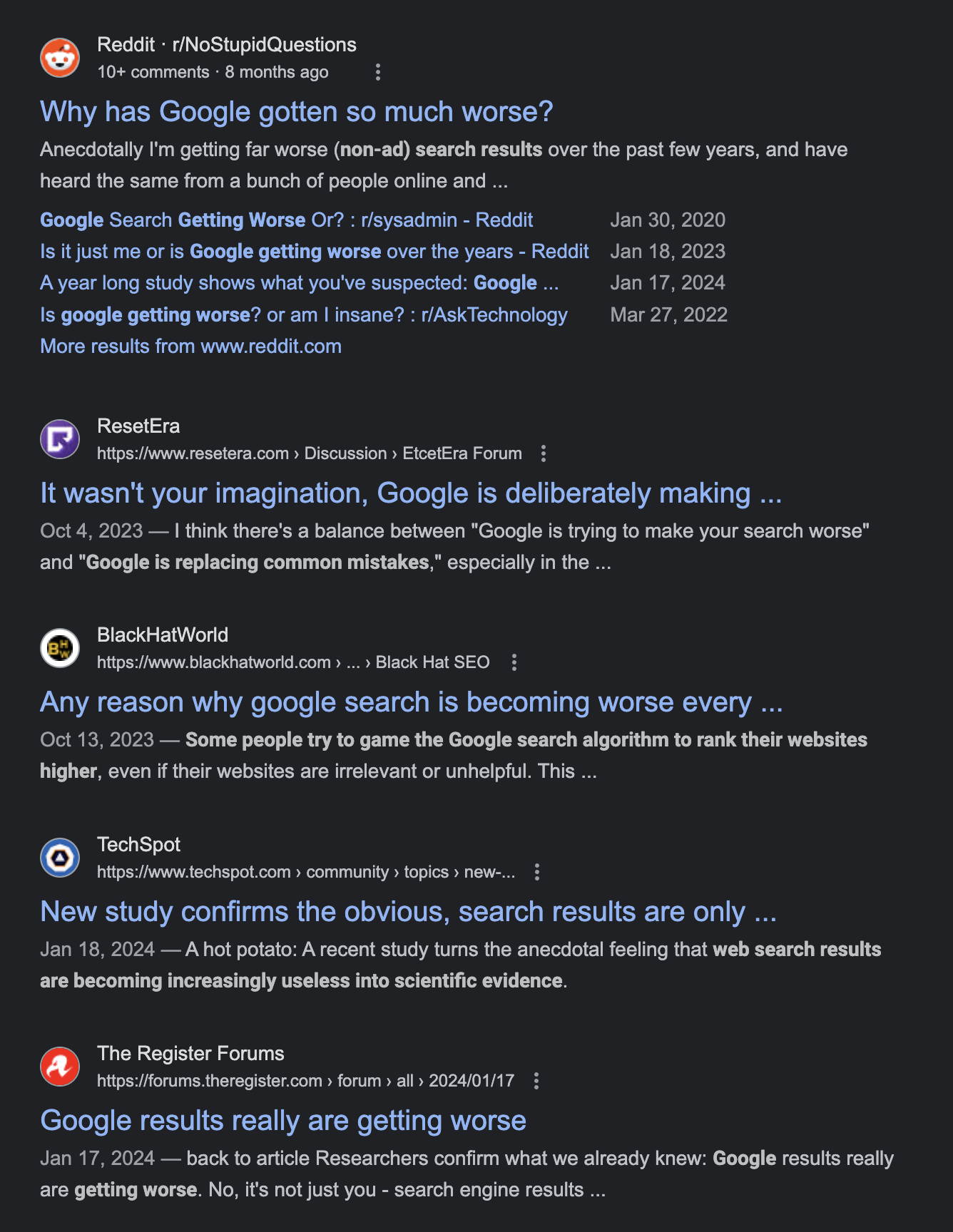
SEO is a way for companies to get more clicks for their website, which in turn gets them more money. SEO happens when a writer for an article puts the most optimized keywords to rank higher on Search Engine pages. When a user looks up, for example, “best phones” or “T-shirts,” they get articles that use SEO to rank higher and give them those first blue links that they usually click on.
Now, SEO isn’t inherently terrible. In fact, Google recommends using SEO if you want to show up in search results. However, SEO is being used to make the internet worse.
Shady companies use SEO to create articles that are poorly written, and that usually don’t answer the question users are looking for. These articles are also filled with affiliate links, which are special links to buy from other retailers who in turn pay the website a commission of their sales. A study from a team of researchers from Leipzig University, Bauhaus-University Weimar, and the Center for Scalable Data Analytics and Artificial Intelligence, found that junk sites are consistently able to get their results to the top of a webpage. The researchers used 7,392 product review searches over three search engines, Google, DuckDuckGo, and Bing. What they found was that the higher ranked pages are more SEO optimized, have lower quality text, and are filled with affiliate links.
In 2023, Gizmodo found that Tech publication CNET deleted thousands of articles to rank higher on the search results. On top of that, CNET also used A.I. to write SEO-optimized articles. After being called out by other websites, they added correction notices to their A.I.-written stories. These A.I. written stories also contained errors that could mislead readers. Before the correction, story bylines would say “CNET money staff” – after being caught, the bylines read “CNET money” and clarified that the article was assisted by an AI engine.
So how is Google going to fix the problem that it’s facing? On March 5th, 2024, Google announced that they’re going to change how the ranking algorithm works for its search engine. Google is always tweaking its algorithms, but a new update, according to Google, could reduce unhelpful content by up to 40%. According to a blog post featuring Google’s VP of Search, Pandu Nayak, Google intends to downrank Scaled Content Abuse, Site Reputation Abuse, and Expired Domain Abuse, among others.
Scaled Content abuse happens when sites publish thousands of low-quality articles that seem to answer the question that is being asked, but don’t. Scaled Content Abuse either uses A.I. or low paid contractors to write these articles. The next example, Site Reputation Abuse, is when a legitimate website leases a part of its website out for spammy content. These websites usually have a section dedicated to coupons or the page itself seems out of place. The last example Nayak brings out is Expired Domain Abuse. This is when someone buys an abandoned high-ranking domain with the intent to boost its search ranking but then fills it with low-quality content.
On top of all this, Google is changing its spam policies to better combat its search problem . Those who are participating in Site Reputation Abuse are given 60 days to stop, however everything else is in effect now. This won’t automatically stop the SEO spam problem but, it’s a good step in the right direction. For now, though, many users have found that appending “Reddit” to the end of their search queries helps them find useful answers to the questions that they may have. However, when many subreddits went private in 2023 to protest Reddit’s API changes, Google’s Senior Vice President of search said that Google users were not quite happy with the search engine.
The next thing that makes Google Search feel worse is ads. In the early 2000s and 2010s, there used to be one to three ads on the top. Nowadays, there could be up to four ads, followed by Google Maps suggestions before users get to the first search result. The ads used to be in green text, however they changed to blue in 2020 to make it look like other search results. The ad label is still there but could be easy to miss if you don’t pay attention. Tech publication TechCrunch called this redesign “Squint or you’ll miss it”.
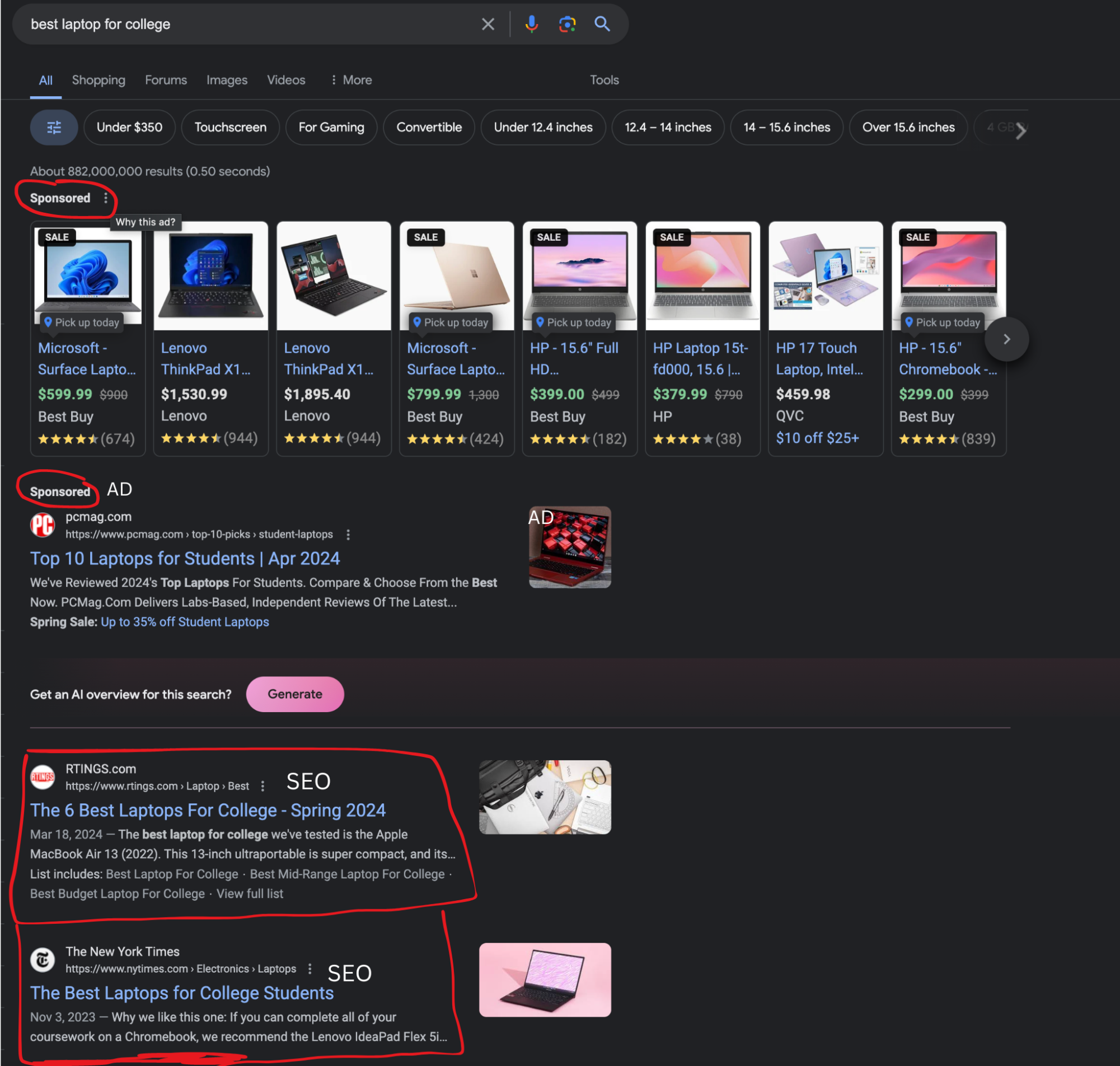
Ads are a common effective marketing tool. Everywhere you look, there’s an ad. According to the University of South California, the average person sees roughly 5,000 ads per day. Most aren’t relevant, but it shows just how prevalent ads are in today’s society. Even though Google does run a search engine and a web browser, its biggest business is advertising. In 2023, it reportedly made 237.86 billion dollars in advertising revenue. To offset any potential costs that it may incur, Google shows more ads which in turn helps it to make more money. It reportedly made 305.6 billion in revenue last year. Google has been inserting more ads into every product it owns in the hopes of making more money, even in its search business. So, if you think you’ve been seeing more ads in search, don’t worry, it’s not just you, there are more ads.
While it seems like Google’s search engine is getting worse, in the study mentioned earlier, researchers found that the company does better in fighting Spam and SEO than its competitors. For as long as Google has been around, there have been people who have tried to game the system, and Google has been fighting a losing battle against spammers. However, things may be changing with Google’s new Search update.
The decline of Google has led to many new search engines to rise. Each offers a different view of how your web searches work. The Search Engine Wars of the early 2000s ended with Google taking over 90% of the market share. The new Search Engine Wars, and the threat of A.I. taking over the search business, could see a new victor.


James Pocket • Sep 13, 2025 at 10:55 AM
I love this article. This is so poignant that it should be at the top of my search results. Well it does touch on some important parts, it’s equally imperative to note that the hardware and software and programming infrastructure of the internet, which is what most people consider Google, is not the reason that Google sucks. Google sucks because people suck. John Locke had the same definition of government that we should have of the internet. It takes people to make both and people make both suck. If the internet was really just the nodes and not the space between the nodes then we would have known what I knew when it was news. And now I’m going to defend an entire race of people – humans. It’s not our language that makes people suck, really. How could the same words mean the same thing to each person equally? You hear a lot of talk about the equality of effort, versus the equality of outcome – what about the quality of input? Why is it that we begin our lives in the Western hemisphere with this idea that the light completely denies creating its shadow, and people completely deny the influence of their own environment and upbringing? Is it good enough for me to communicate well if someone has poor understanding? Does it matter if you can speak French fluently in a house full of deaf mutes who only know American sign Language?
How many ways can we illustrate that our language doesn’t mean the same thing to everybody. Because our legislators, and our executives, and their device known as the judiciary all three have created their own precedence. As if they don’t share a Congressional record for debate reference, they say no we couldn’t possibly read into anything other than our own vices. It’s important to understand the root cause of everything is the mind. The problem is everything begins in a mind but we don’t know who’s mind this began in. You think Shrek has layers – what about the onion router? Bravo to the artist known as the symbol who wouldn’t spell his name p r i n t s to communicate love. And bravo to the author of this article. Google was our first form of artificial intelligence. How much of the internet is made up of ideas that we had haphazardly sitting in the internet mailbox that somebody has to go by and sweep up in their search results and filter out for relevance.?.? How many old email accounts do you have sitting out there – just waiting to be quick claim deeded to some intellectual artificial property owner for dissemination and disbursement into the grand scheme of human knowledge and attempted intelligence? As for myself I’m not going to claim any of them. Those illegitimate ideas are not mine. In case they end up messing up your life later in the search result that you got from taking the internet too seriously. Because either we’re not supposed to do that – or we’re doing it the best we can. Considering what we have to work with is a bunch of people who don’t realize we’re all working together. How many taglines can you end with in one comment section? I don’t know. I’m in autistic 46-year-old and I’m excited because this is one of the best articles I’ve ever read as someone who trains generative artificial intelligence. All intelligence is art, officially – when you’re on this side of the screen all day.
Karen • Mar 22, 2025 at 5:06 PM
Google sucks! Censorship at its finest!
Melanie • Sep 18, 2024 at 12:40 PM
Great article! I have a better understanding of recent Google search critiques. Would be interested in an article about Google’s search criteria. I’m currently researching how the law views SERPs and its relationship with antitrust laws and the first amendment.