








The 4th period bell rings, and everyone in class is locked into their Chromebook working on important assignments. However, one senior is focused on discreetly watching a soccer game in South America, keeping a close eye on the scores and player stats.
At this moment, that game is far more important than schoolwork for one reason, he bet $100 on the under. Despite the questionable legality of placing such a bet, beating the odds can run a serious check for some students.
“I don’t really feel anything about it, it’s just extra cash on the side,” said an anonymous senior, who admits to winning as much as $2,500 on the app Fliff, a popular sports app, # 16 on the app store as far as sports betting goes, and actually is a free to play sports gaming app. “Easy money. I have tons of sports knowledge,” portraying that to win the game, you have to know the game first. Meaning player stats, win rates, and keeping track of that sport, spending hours studying the players play patterns and teams consistent performance.
A Rapid Cultural Shift
He is just one part of a cultural shift regarding how we view sports betting. Up until as recently as 2018, sports betting was completely illegal in the United States. Following a U.S. Supreme court ruling ruled the ban unconstitutional, apps such as DraftKings and FanDuel began to serve adults as digital sports books.
Now, even sports broadcasts advertise these apps, usually with a ticker showing the odds and potential winnings with links to websites encouraging viewers to bet. The American Gaming Association is expecting $1.76b in legal bets to be placed on the upcoming Super Bowl by over 65 million Americans; analysts estimate growth of 25-30% year by year. Showing a sharp reversal from just several years ago.
The age verification has proven too easy to bypass for those underage. A survey conducted by The Eagle’s Eye found that 28% of student respondents either participated in or knew someone who participated in online sports betting. Some have even admitted to using a parent or siblings ID to gain access, as well as using a VPN to access offshore websites hosted in countries with relaxed gambling laws.
Bypassing Digital Guardrails
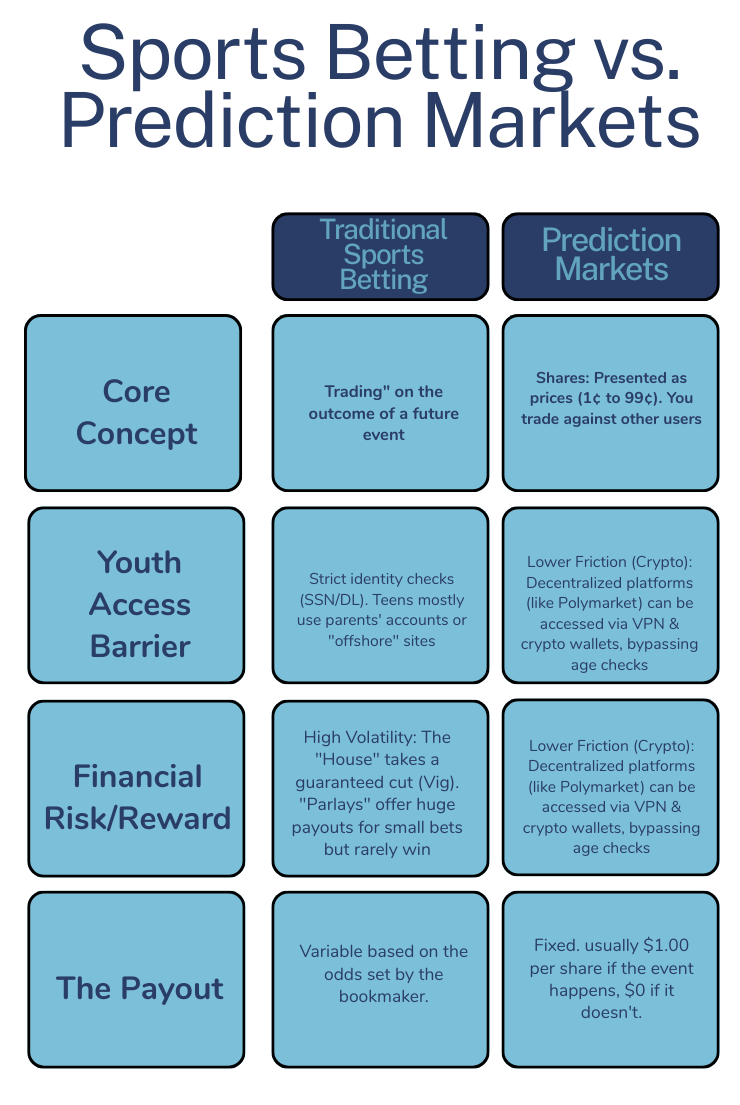
For many students, these age restrictions are merely a suggestion, not a wall. While some apps require strict identity verification, students have found workarounds that range from surprisingly simple to sophisticated. “Usually AI or their parents’ IDs without them knowing,” one senior admitted in the survey when asked how students bypass security measures. Others pointed to “using a VPN for offshore sites,” effectively masking their location to access platforms hosted outside U.S. jurisdiction. This digital loophole has created a whole new demographic for this massive industry.
According to market analysis by Zion Market Research, the U.S. online sports betting market was valued at approximately $14 billion in 2023 and is projected to hit nearly $33 billion by 2032. But the trend goes beyond just picking the winner of the Super Bowl. A new wave of “Prediction Markets” has turned current events into a digital casino, allowing users to bet on everything from election results to economic indicators and even popular media like YouTube videos and shows.
From Gambling to “Investing”
For a generation raised with volatile crypto schemes and rampant day-trading, this doesn’t feel like gambling for some—it feels like investing. Platforms like Polymarket allow users to buy “shares” in an outcome rather than placing a traditional wager. It’s a subtle shift, but a profitable one; reports from the International Banker indicate that in 2025 alone, prediction market platforms generated a combined trading volume of over $37 billion.
The allure of the “big win”—like the senior’s $2,500 payout—is powerful. It fueled the purchase of a new car for one student mentioned in the survey, who “couldn’t believe his eyes” after winning $2,000. But for every success story, there are ten dealing with the “chase”—the desperate need to win back money lost on a bad bet.
The Hidden Cost of the Chase
“I lost 40 dollars, it sucked,” one sophomore said in the survey. Another student noted a concerning pattern among peers: “They keep painting it after they lose,” referring to the habit of doubling down to recover losses, a psychological response to the emotional distress of losing money.
This behavior points to a growing “addiction gap” that experts are beginning to flag. While roughly 3% of the general population shows signs of problem gambling, a poll by Fairleigh Dickinson University found that number jumps to 10% for men ages 18-30, a demographic known to be disposed to risk taking behavior.
The odds of a bet are usually in plain text, the apps blur the line between a game of skill and a game of chance, hiding the risks behind bright colors and a clean UI. As apps like Fliff and PrizePicks continue to monetize the sports fandom, the line between spectator and speculator blurs. For the anonymous senior, it’s just a game of skill. But for the student body as a whole, the question remains: is this a harmless hobby, or a predatory tax on the youth?
Diego Munez, Andrew Ramirez, George Morales, Natan Salgado contributed to this article.