











Austin ISD officials announced progress two weeks ago in addressing the district’s historic $181 million budget deficit last week, unveiling a preliminary plan that slashes $73.8 million from central office and department budgets.
While district leaders have said they are attempting to shield campus-level essentials, internal documents and community feedback suggest that the coming school year will bring disruptive changes to Akins High School.
The community will not have to wait long to see the final plan, as additional cuts and changes are expected to occur over the next month before the district officially adopts its budget. This process will formally begin on May 21, when the Superintendent’s recommended budget is presented to the Board of Trustees, and will culminate on June 18, when the board holds its final vote to adopt the official budget for the 2026–27 school year.
This timeline has sparked widespread anxiety on campus. A recent survey of 42 Akins students and staff members conducted by The Eagle’s Eye revealed that on a scale of 1 to 5, the average concern level regarding the impact of these cuts on daily school life stands at a high 3.95 out of 5. Furthermore, 74% of respondents reported they are already actively following the budget crisis.
Teachers warn of exhausting changes for staff
While the district has protected counselors and librarians from cuts, campus-level shifts are already causing high anxiety. To save an estimated $16 million across secondary campuses, internal staffing recommendations reveal that non-core teachers will be required to teach seven out of eight class periods next year—effectively eliminating one of their two planning periods.
Akins educators warn that this policy is a recipe for operational failure.
“I suspect that it will lead to an increase in teacher burnout and turnover,” said English teacher Alan Brooks, who serves as the Education Austin union steward at Akins.
Brooks speaks from personal experience. A few years ago, he voluntarily chose to teach a seventh class in exchange for extra pay.
“At the end of the year, I decided that I never wanted to do that again because it is exhausting,” Brooks said.
He added that he does not believe the district can meet its deficit targets without directly harming classrooms. “There are some central office positions that are probably a bit redundant… but none of those sorts of things cost enough to cover the budget shortfall.”
Surveyed teachers echoed Brooks’ fears of professional exhaustion. One anonymous Akins teacher warned that teaching seven out of eight periods “will significantly cut down on the time I have to plan and grade, and to meet in ARD and professional development meetings.”
Students are equally protective of their teachers’ planning time.
An Akins senior wrote bluntly about the proposal.
“It’s horrible because they’re already overworked and underpaid,” wrote the senior. “You’re going to have so many teachers quitting, and then [the district is going to be] scratching their heads wondering why.”
Akins CTE programs face ‘severe’ threat
The loss of planning time is poised to hit Akins’ highly regarded Career and Technical Education (CTE) programs especially hard. Akins hosts more CTE programs than any other campus in Austin ISD.
Akins CTE Department Chair Jennifer Segura warned that the hands-on, real-world nature of these classes makes a 7-of-8 teaching schedule nearly impossible to manage safely and effectively.
“Practicum courses require site visits and consistent monitoring of students in the workplace,” Segura said.
“That cannot be done effectively or with fidelity under a 7-of-8 schedule.”
She noted that students enrolled in these specialized practicum courses will ultimately be affected the most.
Moving to a traditional 8-period day to accommodate these teacher workloads is a major point of contention. An overwhelming 83% of Akins survey respondents believe that shifting away from the alternating block schedule to shorter daily classes will negatively affect their learning.
“If we shifted to eight periods today, I would genuinely start to hate school,” wrote Arley Moore, an A-honor roll student. “Nothing could make my learning experience worse than not having enough time to learn the subjects in class.”
Devan Flores, another student respondent, recalled having an 8-class schedule in middle school.
“It is hard to get anything done in that tiny amount of time. It would be exhausting to the students and even more so to the teachers,” she wrote in her response.
In response to the threat of program erosion, Segura co-drafted and co-signed a joint letter from all Austin ISD high school CTE department chairs urging the school board and superintendent to maintain the six-out-of-eight instructional schedule for CTE educators.
The letter highlights the massive stakes involved: during the 2024–25 school year, AISD students earned a record-breaking 2,208 industry-based certifications. These certifications are a critical indicator of College, Career, and Military Readiness (CCMR), directly impacting state accountability ratings while preparing students for the workforce.
“This milestone is evidence that Austin ISD’s investment in CTE is producing tangible results for students while strengthening the district’s accountability outcomes,” the department chairs wrote.
They argued that CTE teachers face demands that mirror core academic subjects in complexity. Many CTE teachers manage three or more distinct course preparations, often teaching “stacked” classes with students of varying skill levels in the same room. The letter notes that planning periods are necessary to maintain dual-curriculum expectations, manage complex lab equipment, grade certification preparation, and ensure classroom safety.
Community Voices Demand Protection for Planning and Class Sizes
The concerns raised by Akins teachers align closely with broader district feedback. In a recent community-wide survey that garnered nearly 7,000 responses, stakeholders overwhelmingly demanded that classroom environments be prioritized.
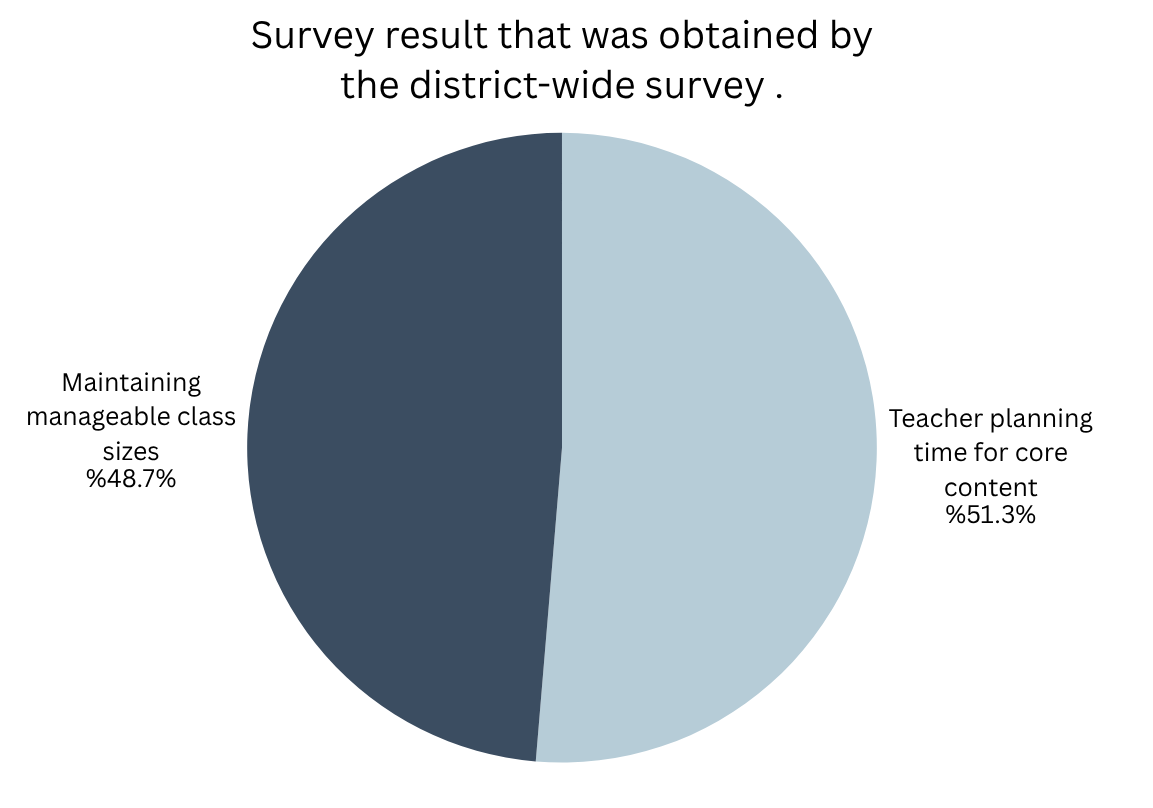
According to the district-wide survey data, 71.4% of respondents ranked teacher planning time for core content as a top priority to protect, followed closely by maintaining manageable class sizes at 67.7%.
Locally, the priorities align closely with those of the broader district. When Akins students and staff were asked in the campus poll which specific programs must be shielded from cuts, Mental Health and Counseling Services emerged as the highest priority (selected by 26 respondents), followed by Fine Arts (24 respondents) and CTE programs (22 respondents).
Senior Kyndra Azuara emphasized the cultural importance of preserving the arts: “If Fine Arts was cut, it would change my view on Akins and AISD because it’s a way that people express themselves and it can be an escape from the real world. Learning isn’t always black and white; art makes it colorful.”
Despite this strong public feedback, teacher union Education Austin warns that cuts are still headed straight for the classroom. In a message to members, the union pointed out that losing planning time is simply a way to reduce staffing levels.
“How do these things save money? They save money only by eliminating positions,” the union wrote, adding that district officials have been unable to provide a specific count of how many positions will be lost, raising concerns about eventual layoffs.
Education Austin also criticized a perceived double standard in the administration’s budget-saving measures, noting that while the district plans to cut stipends for vital campus roles like school psychologists, it has spared administrators’ perks.
“There is nothing in their summary about cutting the cell phone and travel stipends for administrators,” the union stated, noting that some administrators receive travel allowances of up to $9,000 even if they rarely travel. “They need to eliminate those stipends if they are serious about closing the deficit. They shouldn’t just target the people who are working with the students.”
Looking forward
While Superintendent Segura’s preliminary plans have spared some positions—such as leaving the Deputy Superintendent for Business and Operations role vacant to cut administrative overhead—the community remains on edge.
Educators like Brooks point out that while the immediate future is challenging, the long-term solution lies at the state level.
“The important thing to remember is that this budget crisis isn’t going to last forever,” Brooks wrote. “Next year is a new legislative session and another opportunity for the state to increase school funding, and maybe adjust the recapture system to be fairer to districts like Austin. So, we need to be careful not to cut things that can’t easily be restored.”
Silas Baker contributed to this article.