










When James Hoag, the musical director at Akins High School, was looking for the next big production for the theatre department, he looked back to his own roots. Growing up in a church choir, he found a personal connection to the music and meaning of Sister Act.
“I saw meaning and connections to my personal life, and it was a huge motivator for me,” Hoag said.
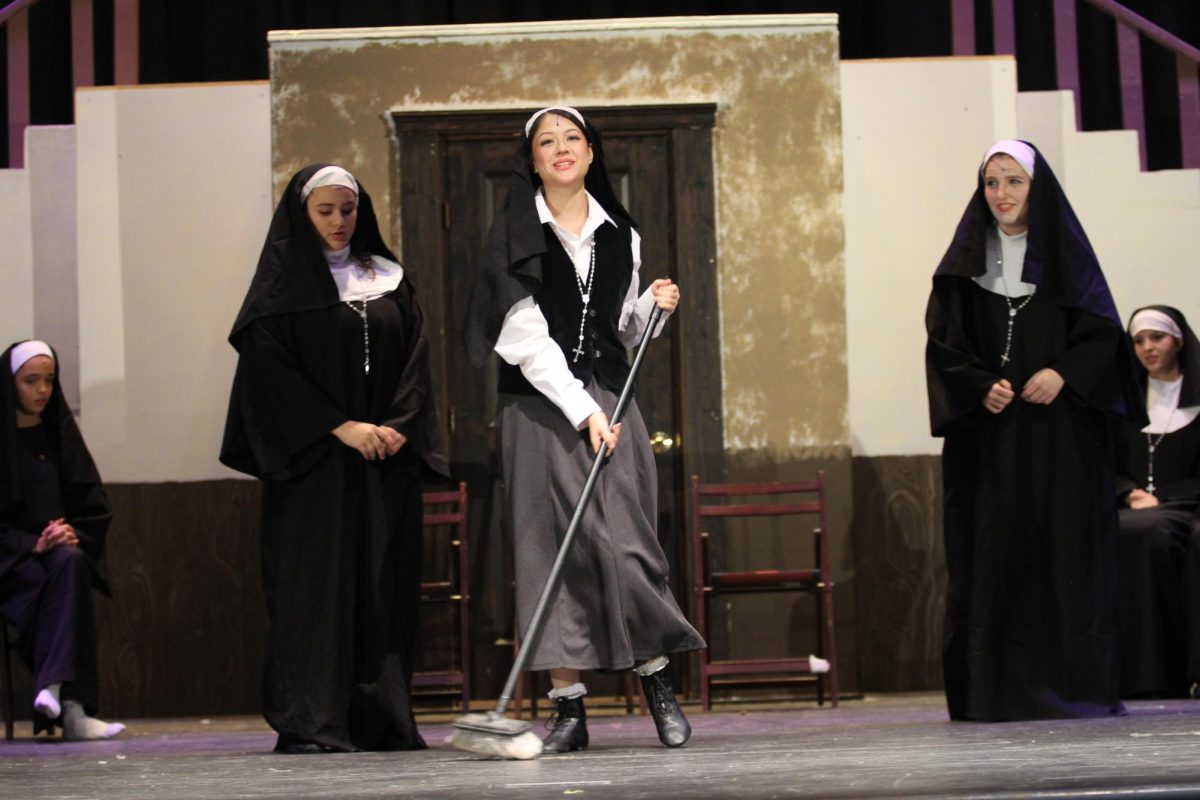
That motivation transformed the Akins stage into a collision of two worlds: the gritty underground of crime and the holy sanctuary of a convent. Sister Act, an American comedy musical, tells the story of a lounge singer forced into hiding after being placed in a witness protection program.
In the musical, the protagonist, Deloris (played by Keira Calswell), is a singer in a nightclub. Her boyfriend, Curtis Jackson (played by George Whitehurst), gives her a poor gift. When she attempts to return it, she witnesses Curtis shooting an informant, causing him to try to murder her as well.
Police Lieutenant Eddie Souther (played by Jack Robison) puts her in witness protection and brings her to a convent in a run-down San Francisco neighborhood, allowing her to hide there as a nun with Monsignor O’Hara’s (played by Jack Culbertson) conviction.
Deloris initially struggles to live as a nun, finding it hard to stay in line with the rules and procedures, but fortunately, she grows to become friends with the other nuns. One night, she decides that she needs a break and sneaks out to a bar with Mary Patrick (played by Camilla Carlson) and Mary Robert (played by Leah Rodriguez). However, they are caught by the Mother Superior (played by Olivia Cormier), who orders Deloris to join the struggling choir as opposed to kicking her out.
Deloris is elected to direct the choir and transforms it with her singing experience. The next Sunday’s Mass features the newer and improved choir leading a traditional hymn, “Hail Holy Queen,” in a combined gospel and rock-and-roll interpretation. In contrast to Mother Superior’s irritation, Monsignor O’Hara is in favor of this unconventional performance; with the attraction of new service members, he encourages the nuns to keep this new style of music.
Unfortunately, the choir’s new singing efforts attract media to the parish, catching the eye of Curtis Jackson. He orders his men to find and kill Deloris. Ultimately, the nuns fight off Curtis’s men and prevent Curtis from shooting Deloris by standing up for her. Curtis tries to shoot her but is instead shot in the shoulder by Eddie Souther, saving Deloris and concluding the play.
Playing the Villain
For George Whitehurst, stepping into the shoes of the antagonist, Curtis Jackson, required a complete personality shift.
“I didn’t know much about the role or show, and wanted the male lead,” Whitehurst said.
However, becoming a villain wasn’t second nature.
“[I had to] get into a more cocky and crueler attitude which is the opposite of me,” Whitehurst said. “It was weird and fun getting out of my comfort zone… I just had to work on the song.”
Whitehurst noted that the most challenging part of the production was maintaining the mindset of a character he fundamentally disagreed with.
“I expect the audience to kinda be disgusted at the character, but think he’s weirdly funny,” he said. “Of course, he’s not a good person, but people in that role are somewhat charming, overall disgusted, but weirdly intrigued.”
Despite the dark nature of the character, Whitehurst found joy in the performance, specifically a musical number involving some provocative dance moves.
“I traumatized a lot of people, and had a lot of fun,” Whitehurst joked. “It was nice to sit back, have fun, and [traumatizing] family and friends was a nice little bonus.”
Behind the Scenes
While the actors brought the drama to the stage, the technical crew worked tirelessly to ensure the magic happened seamlessly. Draven Barerra, who typically performs as an actor, took a different approach for this production, working the flyrail.
“I didn’t choose, I chose light and sound when I tried, but Mr. Hoag put me on the flyrail,” Barerra said.
Having spent six or seven years in theatre, largely on stage, Barerra offered a unique perspective on the transition from cast to crew.
“Not having to do anything the actors do [was my favorite part],” Barerra said. “I chose to do tech cause I’m tired of being an actor, it was fun having more time to eat, and I had extra time to myself.”
However, Barerra noted that the pressure on technicians is distinct and unforgiving.
“If a tech messes up their part it is blaringly obvious compared to an actor messing up and improving their line,” he said. “If tech is wrong… it’s very obvious.”
Despite the long rehearsals—and the challenge of staying awake in the dark fly loft during the fifth run-through—Barerra found the experience rewarding.
“Watching the show come together… going from what I first saw to the shows we performed to an actual audience, it was like night and day,” Barerra said.
A Director’s Vision
Bringing the show together required collaboration between the musical and technical directors. Director Le Easter said that the production was unique because the songs truly revealed who the characters were.
“I was excited to use that production with our musical theatre talent,” Easter said.
However, the ambitious nature of the show presented logistical hurdles. Easter noted that building the numerous set pieces required for the various settings was the most challenging aspect, alongside creating specific costumes, such as the “tear-away suit” for the character Sweaty Eddie.
For Hoag, the biggest challenge was scheduling, with conflicts causing absences at nearly every rehearsal. Yet, seeing the final product made the struggle worthwhile.
“The first time we ran through the whole show, it was very messy and very fun, and I saw it click for all the actors and technicians,” Hoag said. “I think Sister Act is my favorite show that I’ve worked on… [I’m] incredibly proud of it.”
